

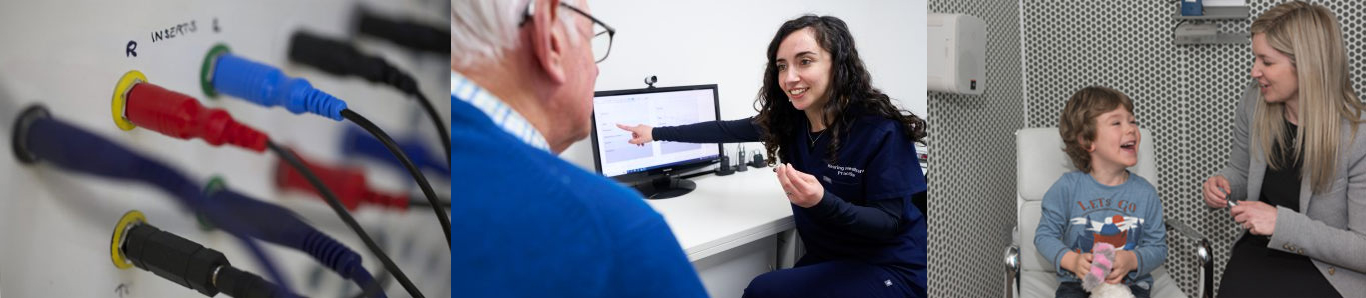
The human side of hearing care.
When people think about hearing aids, the focus is often on technology.
Advertising talks about artificial intelligence, speech clarity, noise reduction, Bluetooth connectivity, rechargeable batteries, and revolutionary new features. The message is usually the same. Buy the latest hearing aid and your hearing problems will disappear.
However, hearing care is far more complex than that.
At Hearing Healthcare Practice in Harpenden, we have long believed that successful hearing outcomes depend just as much on the relationship between patient and audiologist as they do on the technology itself.
A hearing aid is a tool. The real difference comes from the skill, patience, counselling, and ongoing support provided by the professional fitting and managing that technology.
Importantly, this is not simply opinion. Research has shown that the quality of care and the clinical relationship can have a measurable impact on hearing aid success.
What did the research show?
A widely discussed presentation at the European Union of Hearing Aid Acousticians (EUHA) Congress back in 2017 highlighted important findings. (Since 2017, with the rise and rise of hearing technology, the conclusions are even more relevant today as they were then).
The presentation explored the idea that a ‘premium clinic’ may actually be more important than a ‘premium hearing aid.
The article discussing this work can still be viewed here:
The findings suggested that the expertise of the clinician, the time spent with the patient, and the quality of counselling significantly affected outcomes and satisfaction.
In simple terms, people do better when they feel listened to, supported, understood, and professionally guided.
Why hearing care is about far more than devices.
Hearing loss is deeply personal. It affects communication, confidence, relationships, social interaction, and emotional wellbeing. Some patients feel anxious about hearing aids. Others worry they will not cope with change, or fear losing independence.
No hearing aid, however advanced, can solve those concerns on its own.
That is where the audiologist becomes essential.
A skilled audiologist does far more than simply programme a device. They help patients understand their hearing loss, manage expectations, adjust gradually to amplified sound, and build confidence over time.
The best outcomes usually happen when patients trust the person guiding them through that journey.
Technology still matters, but it is not the whole answer.
Modern hearing technology is remarkable.
Today’s hearing aids can analyse sound environments in real time, reduce background noise, stream phone calls directly to the ears, and adapt automatically to different listening situations.
These advances genuinely improve lives.
However, even the most sophisticated hearing aid can disappoint if it is not properly selected, fitted, adjusted, explained, and supported by an experienced clinician.
Research consistently shows that hearing aid success depends heavily on factors such as:
- Accurate assessment
- Careful fitting and fine tuning
- Realistic counselling
- Follow-up care
- Patient confidence
- Trust in the clinician
- Ongoing support and adjustments
Without those elements, technology alone rarely delivers its full potential.
The importance of expert time and patience.
One of the biggest challenges in modern healthcare is time.
Many industries increasingly focus on speed, automation, and efficiency. Hearing care should not become purely transactional.
At Hearing Healthcare Practice, we believe hearing rehabilitation works best when patients are given time.
Time to ask questions.
Time to adjust.
Time to build trust.
Time to understand what is happening.
Sometimes the most valuable part of an appointment is not the hearing aid itself, but the reassurance, explanation, and careful listening provided by the audiologist.
Why independent audiology matters.
Independent hearing care clinics like Hearing Healthcare Practice place strong emphasis on continuity of care and long-term relationships.
Seeing the same audiologists regularly can make a significant difference. Over time, the clinician develops a deeper understanding of the patient’s hearing needs, lifestyle, concerns, and preferences.
That continuity allows care to become more personalised and more effective.
It also creates something that technology alone cannot provide: confidence.
Hearing care is ultimately about people.
Technology is a means to an end.
The real goal is helping people reconnect with conversations, family life, music, work, and the world around them.
That takes expertise, empathy, patience, and trust.
At Hearing Healthcare Practice in Harpenden, we continue to champion an approach where people come first and technology supports that relationship, rather than replacing it.
Because hearing care is not just about hearing aids.
It is about human connection.
Looking for professional hearing care in Harpenden?
Hearing Healthcare Practice provides independent audiology services with an award winning focus on personalised care, long-term support, and clinical excellence.
Whether you are considering hearing aids for the first time or looking for ongoing hearing care support, our experienced team is here to help guide you through every stage of your hearing journey.