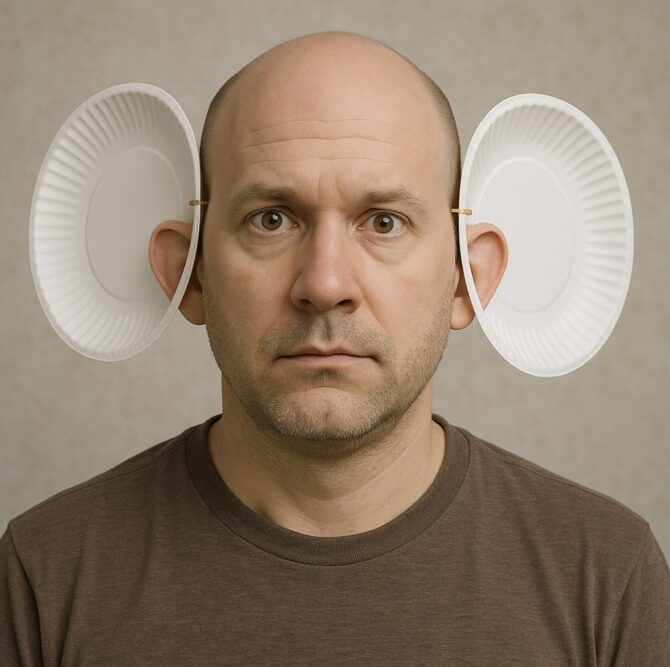
Before he got his hearing aids, my father “invented” a device to help him hear better. It consisted of two paper plates and an elastic band, ingeniously positioned to form permanent “ear cups” around his ears. They worked surprisingly well — until my mother put a stop to the contraption’s public appearances.
It turns out, however, that my father was on to something. The simple act of cupping your hands behind your ears is of course an ancient and natural way to boost hearing. By creating a larger, forward-facing surface, you capture and focus more sound waves — exactly the same principle that animals have been refining for millions of years (and which are now utilised in the latest hearing technology).
Which got us to thinking… which creature has the best hearing in the natural world?
The Great Grey Owl: Nature’s Ultimate Listener
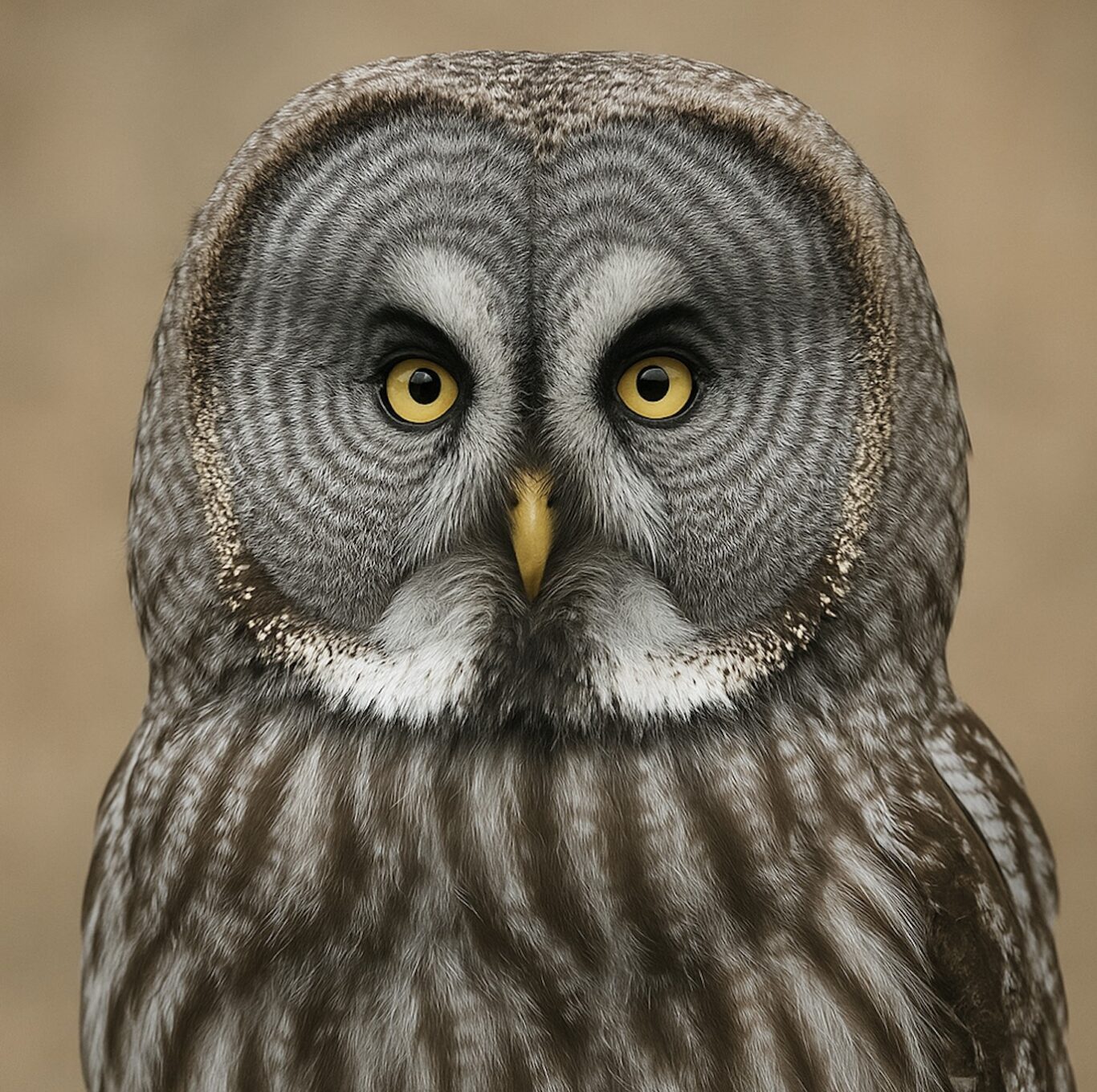
Many animals hear far better than humans, but one stands out: the great grey owl (Strix nebulosa). This silent hunter of the world’s cold northern forests can detect the faint rustle of a vole moving under more than half a metre of snow — even when the world around is completely still.
Unlike humans, whose ears are symmetrically placed, the great grey owl’s ear openings are slightly offset — one is higher than the other. This clever asymmetry allows it to pinpoint the exact location of a sound in three-dimensional space. Combined with a vast, dish-shaped facial disc of feathers that funnels sound directly to the ears (a built-in, feathery version of my father’s ingenious invention), this bird’s hearing is thought to be among the most sensitive in the animal kingdom.
The Power of Moveable Ears
Owls aren’t the only ones who use clever ear design to hear better. Cats, foxes, and bats all have mobile, cup-shaped ears that can swivel and tilt toward a sound source. This movement helps them locate prey, avoid predators, or communicate over long distances.
Humans lost that ability somewhere in our evolutionary past, though the tiny muscles that once moved our ears are still there — now largely redundant. Next time you find yourself instinctively cupping your ear to hear better, you’re using the same principle as a cat turning its head or an owl angling its facial disc.
Lessons from Nature
At the Hearing Healthcare Practice, we’re continually fascinated by how nature solves problems of hearing, sound direction, and communication. From the feathered sound collectors of owls to the radar-like echolocation of bats, these natural adaptations inspire better understanding of how our own ears work — and how to help when they don’t.
And while my father’s homemade hearing “wings” might never have caught on, today’s hearing technology does much the same job, just with far more style. The latest hearing aids use directional microphones and sophisticated sound processing to help you focus on what matters most, much like an owl focusing on a mouse beneath the snow.
So perhaps my father wasn’t so eccentric after all — just a little ahead of his time.